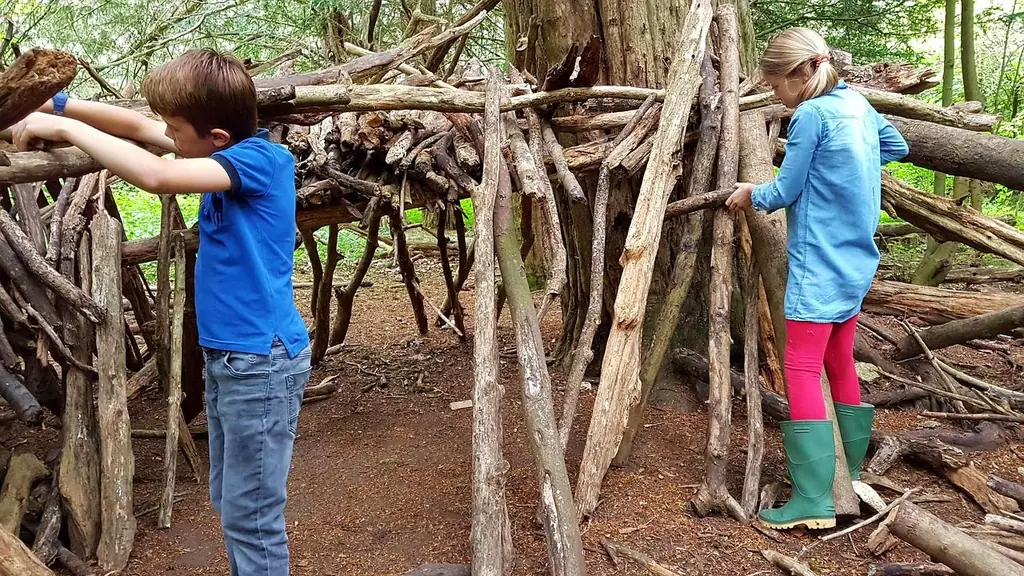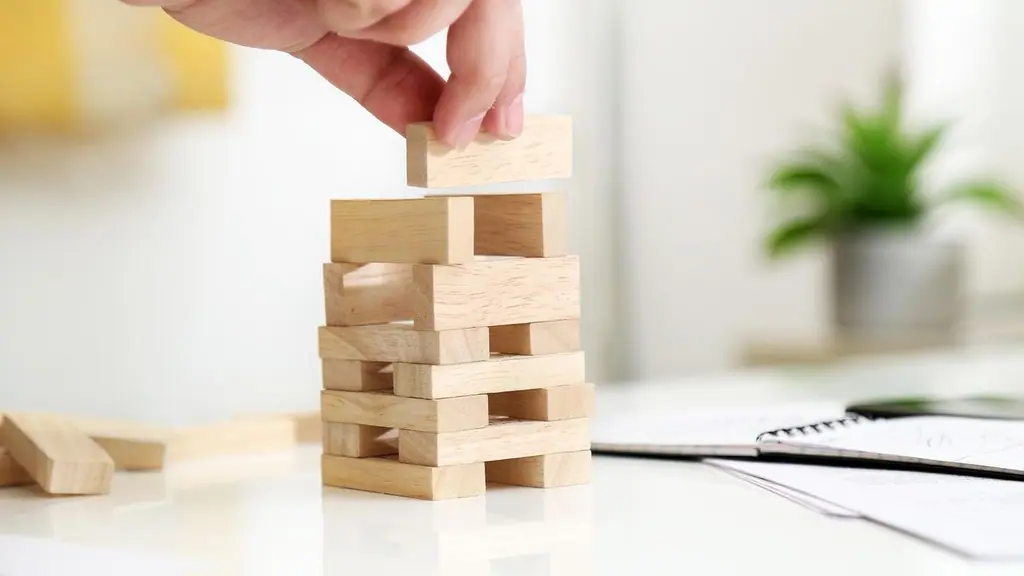
"Build the tallest tower you can" is one of the best challenges ever invented, partly because it always ends in a satisfying crash. Add a small twist (it has to hold a stuffed toy, it has to survive a fan, you only get twenty cups) and suddenly a child is planning, testing and improving like an engineer.
This guide is a ladder of building challenges in three families, towers, bridges and ramps, arranged by age. Each rung has materials, a clear "it worked if…" test, and questions to ask instead of giving answers. Start where your child is, not where the age label says. Plenty of 10-year-olds enjoy a preschool challenge done fast, and some 5-year-olds are ready to go further.
You’ll need
- Building materials: wooden unit blocks or large bricks, paper or plastic cups, index cards, paper, cardboard, paper towel tubes, craft sticks, drinking straws
- Joining: masking tape, painter's tape, paper clips, clothespins (no glue needed for most challenges)
- Testing loads: small toys, a bag of dried beans or rice, a stack of books, a toy car
- Measuring: a tape measure or ruler, a kitchen timer, a notepad for results
- Ramps: a long board, a baking tray, thick cardboard, books to raise one end
- Tools for older kids: child-safe scissors; for big kids only, sharper scissors with supervision
How every challenge works
Each challenge follows the same simple loop. You might know it as the engineering design cycle; with children, four words cover it.
- Plan. Set the goal and the limits ("tallest tower using 20 cups"). Ask for a prediction: "How tall do you think it will be?"
- Build. Let the child build their own way. Hold back on fixing.
- Test. Run the success test: measure, add weight, roll the car. Write down or draw the result.
- Improve. Ask what happened and what they would change. Build again and compare with the first result.
The second round is where the learning shows: a child who widened the base, folded the paper or lowered the ramp because of what they saw is reasoning from evidence.
Variations by age
Preschool (3–5): big pieces, one goal
| Challenge | Materials | It worked if… | Ask |
|---|---|---|---|
| Tower for teddy | Large blocks or cups | A small soft toy can sit on top for a count of five | "What made it wobble? What if the bottom was wider?" |
| Bridge for cars | Blocks and a strip of cardboard | A toy car rolls across without the bridge falling | "Where does it need holding up?" |
| Ramp race | A board or tray propped on books | A car rolls off the end on its own | "What happens if we add another book?" |
Keep sessions short and celebrate crashes. Talk about what you see: "taller," "wider," "on top," "underneath," "steeper."
Early school (5–8): limits and measuring
| Challenge | Materials | It worked if… | Ask |
|---|---|---|---|
| 20-cup tower | 20 paper cups, 10 index cards | It stands for 10 seconds; measure the height | "Which layer is the strongest? Why?" |
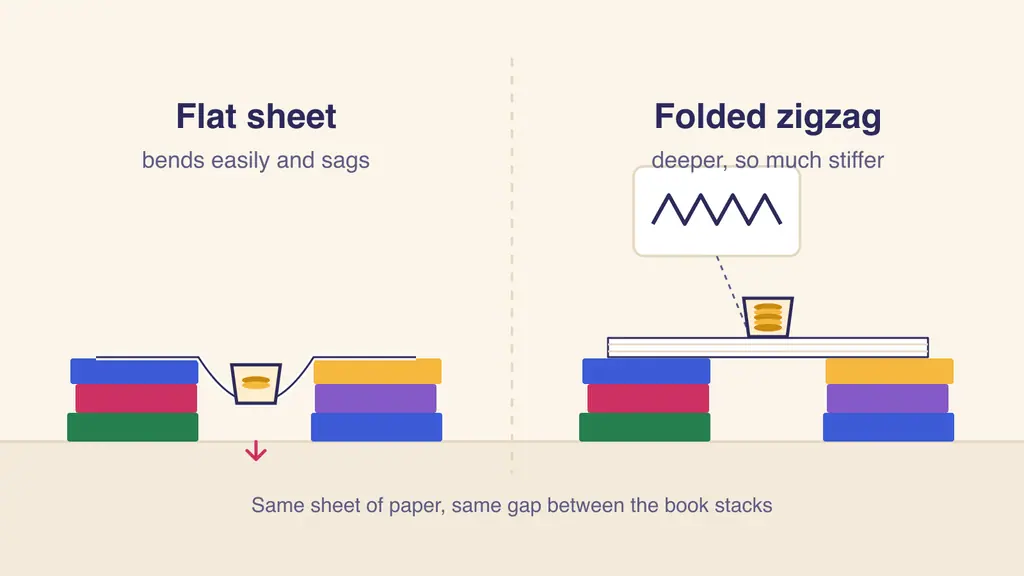
| Book bridge | Paper, tape, two stacks of books 8 inches (20 cm) apart | It holds a toy for 10 seconds | "Did folding change anything?" |
| Ramp distance | Board, books, tape measure | Car rolls at least 3 feet (1 m) past the end | "Will higher always mean farther?" |
Introduce recording: a simple table of "what we tried" and "what happened." Our paper bridge challenge is a full version of the bridge activity.
Big kids (8–12): constraints, budgets and trade-offs
| Challenge | Materials | It worked if… | Ask |
|---|---|---|---|
| Earthquake tower | Straws, tape, a tray of jelly or a shaken baking sheet | It is at least 12 inches (30 cm) tall and survives 10 seconds of shaking | "How did you brace it? Where did it fail first?" |
| Budget bridge | Craft sticks, paper, tape; each item has a "price" | Spans 12 inches (30 cm), holds the most weight per "dollar" spent | "Is the strongest design also the best value?" |
| Marble-free ramp maze | Cardboard, tubes, tape, a toy car or ball over 1.75 inches (44 mm) | The ball or car travels from top to bottom in as long a time as possible | "Where does it slow down? Why?" |
For a longer ramp project, try our cardboard marble run, and plan big builds on paper before cutting anything.
Running challenges with siblings or a group
Mixed ages can work well if everyone has a role that fits. Give the youngest builder the job of tester ("you get to put teddy on top"), a middle child the job of builder and an older child the job of recorder or timekeeper, then rotate. For groups of friends, pairs usually work better than teams of four, where one child tends to do everything while the others watch.
Keep the competition gentle. Instead of a single winner, give awards for the tallest, the most creative, the best improvement between rounds and the cleverest idea that did not work. Celebrating a good failure tells children that testing ideas matters more than getting it right the first time.
Questions that keep children thinking
Asking good questions is more useful than knowing the physics. A few that work at any age:
- "What do you predict will happen?"
- "What did you notice when it fell?"
- "Which part is doing the most work?"
- "What is one thing you could change?"
- "How could we make it a fair test?"
- "What would you do with twice as many pieces? With half?"
Try not to rescue a failing build. "It fell down. What's your next idea?" is more powerful than a fix.
Safety first
- Small parts and under-3s: Cups, blocks and boxes are fine for toddlers, but keep straws cut into pieces, paper clips, beans, rice, coins and small toy pieces away from children under 3 and any child who still mouths objects. The AAP lists small objects and toys with small parts among common choking hazards. Watch for older siblings handing pieces to younger ones.
- Balls: Use balls bigger than 1.75 inches (44 mm) across when toddlers are around; smaller balls and marbles are choking hazards.
- Scissors by age: Preschoolers use blunt-tipped child scissors with help; early-school children use child scissors independently; sharper scissors for big kids with supervision. Craft knives are for adults only.
- Heavy loads: Test with soft or light loads. Do not stack heavy books high on a tower that could fall onto feet, and keep tall towers away from faces.
- Earthquake trays: Keep jelly or water trays low and supervised; wipe up spills to prevent slips.
- See our general safety principles.
What they’re learning
Building challenges give children a chance to practice predicting, testing and revising, along with measuring and spatial language. A study in Child Development found that 3-year-olds' skill at copying block models was linked with their early math performance, and a large U.S. study in Psychological Science found that children whose parents reported more play with puzzles and blocks tended to score higher on a spatial block-design task. Both studies show associations rather than cause and effect, so think of building as one enjoyable way to exercise these skills.
Grown-up tip
Keep a "challenge box" with cups, cards, tape, a tape measure and a notepad. When the materials are already gathered, a challenge takes one minute to start, not ten.
Where to go next
For more on how blocks and bricks relate to spatial thinking, read blocks, bricks and spatial reasoning. If you want quick, low-prep ideas with straws and cups, try our kitchen-table building projects, or print the construction challenge cards and let children draw a mission at random.
Sources
- Better Kid Care, Penn State Extension
- Building Blocks for Developing Spatial Skills: Evidence From a Large, Representative U.S. Sample, Psychological Science (Jirout and Newcombe, 2015)
- Deconstructing Building Blocks: Preschoolers' Spatial Assembly Performance Relates to Early Mathematical Skills, Child Development (Verdine et al., 2014)
- Choking Prevention for Babies & Children: What Every Parent Needs to Know, American Academy of Pediatrics (HealthyChildren.org)
- Play, National Association for the Education of Young Children