Spatial reasoning is the ability to picture shapes and spaces in your head and work with them: turning an object around mentally, seeing how pieces fit together, reading a map, judging whether the couch will go through the door. It turns up everywhere from packing a suitcase to geometry class, and it is one reason construction toys get so much attention from researchers and parents alike.
The research is genuinely interesting. It is also easy to overstate. This guide walks through two well-known studies, explains what they can and cannot tell us, and then gets practical: which construction toys suit which ages, how to talk during block play, and what to watch for on safety.
What one study found about 3-year-olds and blocks
A study led by Brian Verdine, published in Child Development in 2014, looked at 102 three-year-olds. Children were shown small models made of interlocking blocks and asked to build copies. The researchers scored not just whether the copy was right, but how children placed and oriented each piece.
Three findings stand out:
- Spatial assembly and early math went together. Children's skill at copying the block models predicted a significant share of the differences in their math performance at the same age, even after accounting for other factors.
- Gaps appeared early. Children from lower-income families were already behind on the block task at age 3, and their parents reported using fewer spatial words, such as "above," "corner" or "turn."
- No difference between boys and girls on the block task at this age.
What a large national sample found
A 2015 study in Psychological Science by Jamie Jirout and Nora Newcombe used data from the large, nationally representative sample that was used to standardize a widely used children's intelligence test. Parents reported how often their children played with spatial toys like puzzles and blocks.
Children whose parents reported more spatial play tended to score higher on Block Design, a task where children reproduce patterns using colored blocks, even after controlling for other thinking skills. That link was similar for boys and girls and across income groups. Boys were reported to do more spatial play than girls, but this did not fully explain boys' higher Block Design scores. The authors themselves call for future research into the quality of play, not just the amount, and into the mechanisms needed to show cause and effect.
Correlation, causation and what to take from it
Both studies show associations. They do not prove that playing with blocks causes better spatial or math skills. A few other explanations are possible:
- Children who are already good at spatial tasks may enjoy block play more and seek it out.
- Families who buy and play with blocks may also do many other things that support learning, such as talking more about shapes and numbers.
- Parent reports of play frequency are estimates, not precise measurements.
The fair takeaway is modest but useful: building, puzzles and talking about space are linked with spatial skills, they are enjoyable, inexpensive and low-risk, and there is a reasonable case for including them in a child's play diet. That is a better reason to buy blocks than any promise of a higher test score.
Construction toys by age
| Age band | Good options | What to look for | Notes |
|---|---|---|---|
| Toddlers (1–3) | Large soft blocks, chunky wooden blocks, large interlocking bricks designed for under-3s, stacking cups | Pieces too big to fit in the mouth; smooth, sturdy, non-toxic finishes; labeled for under 3 | Toddlers mostly stack, knock down, carry and fill containers. That is the right play for this age. |
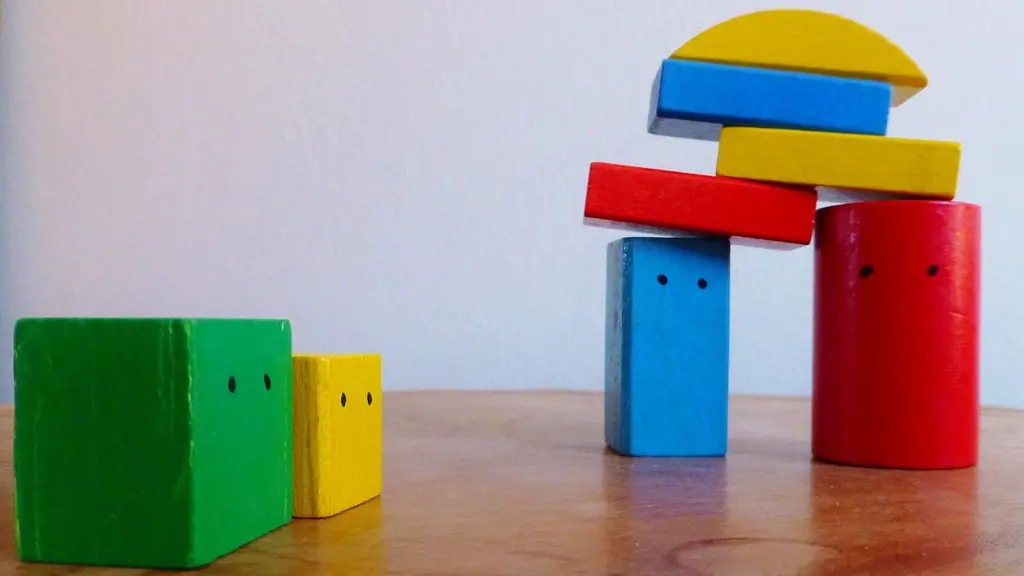
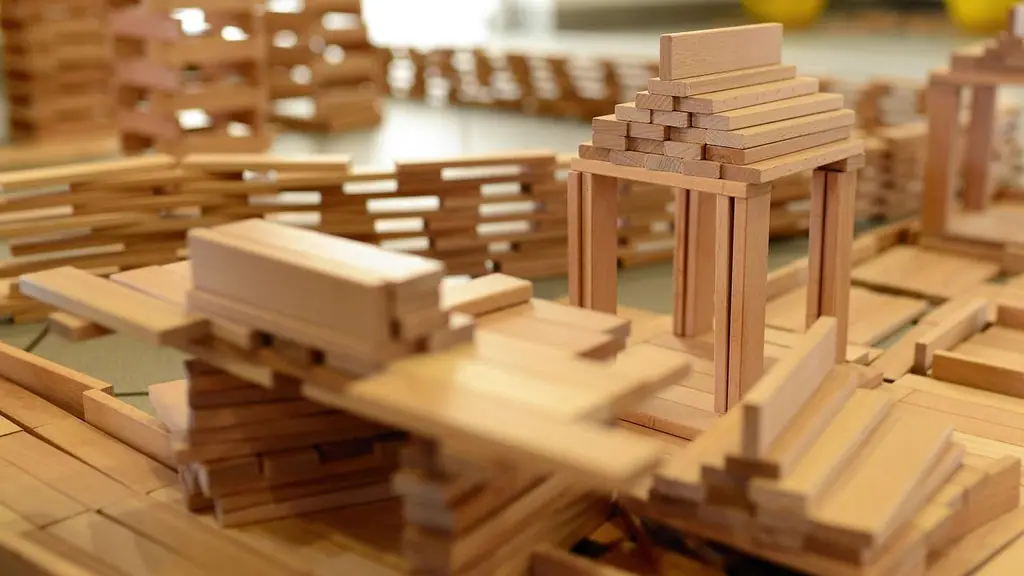
| Preschool (3–5) | Wooden unit blocks, larger interlocking bricks, cardboard blocks, simple pattern blocks | Enough pieces for real structures; a mix of shapes such as arches and ramps | Building enclosures, roads and towers; first attempts at copying a simple model. |
| Early school (5–8) | Standard interlocking bricks, magnetic tiles (see safety), construction sets with large plastic nuts and bolts, marble-free ramp sets | Sets that allow free building as well as instructions | Following picture instructions is itself a spatial skill. Alternate between kit builds and free builds. |
| Big kids (8–12) | Smaller bricks and technical sets, wooden construction kits, cardboard engineering, model-making | Challenging instructions, moving parts, room to modify | Encourage designing their own models and drawing plans first. |
Open-ended sets usually get more use over the years than sets that build one thing. Our checklist for choosing open-ended toys can help, without any brand rankings.
How to talk during block play
The Verdine study's finding about spatial words suggests one easy thing every adult can do: narrate space. Not a lecture, just naming what you see.
- Position: on top, under, beside, between, behind, in front of
- Shape and size: taller, shorter, wider, curved, flat, corner, edge, half
- Movement: turn it, flip it, slide it, rotate it, line them up
- Planning: "What will you build first?" "Will it fit through there?"
- Copying games: build a small model and ask your child to copy it, then switch roles.
Building without buying
You do not need a shelf full of sets to give children rich construction play. Cardboard boxes, paper towel tubes, empty food packaging, clothespins and masking tape make excellent building materials, and they come with an extra spatial challenge: nothing is a standard size, so children must judge what will fit. Sofa cushions and sheets turn into large-scale construction when you build a fort, and outdoor sticks, stones and logs invite building on a bigger scale still.
If you do buy, a single generous set of plain blocks or bricks usually gets more use than several small themed kits. Add a few accessories over time, such as toy vehicles, small figures or fabric scraps, so that building connects with pretend play and storytelling.
Safety first
- Small parts and under-3s: Federal rules ban small parts in toys intended for children under 3, and define a "small ball" as one that passes through a 1.75-inch (44.4 mm) opening. Keep older children's bricks, small pieces and marbles away from toddlers and any child who mouths objects.
- Magnets: CPSC warns that if two or more magnets are swallowed they can attract each other through the intestines, causing serious injury that may need surgery. High-powered magnets are much stronger than ordinary toy magnets. If you suspect a child has swallowed a magnet, get medical care immediately.
- Magnetic tiles and magnet toys: The AAP advises checking magnetic toys often for cracks where a magnet could come loose, supervising young children, picking up stray pieces and keeping rare-earth magnet sets out of the home. Discard any tile with a loose or exposed magnet.
- Tall towers: Keep heavy blocks low, and keep faces and toes clear of big structures when they fall.
- Age labels: Follow the manufacturer's age guidance. See our toy safety checklist by age.
What they’re learning
During construction play, children may practice mentally rotating shapes, matching parts to a plan, using position words, estimating and comparing sizes, persisting through collapses and cooperating on shared builds. Research links block and puzzle play with spatial skills and early math, but those studies show associations rather than proof of cause.
Putting it to work
Ready-made ideas help. Our STEM building challenges by age turns blocks and cups into towers, bridges and ramps with clear goals, and older children can take spatial planning to a bigger scale with engineering a bigger fort. For more ideas suited to the youngest builders, browse our toddler activities.
Sources
- Deconstructing Building Blocks: Preschoolers' Spatial Assembly Performance Relates to Early Mathematical Skills, Child Development (Verdine et al., 2014)
- Building Blocks for Developing Spatial Skills: Evidence From a Large, Representative U.S. Sample, Psychological Science (Jirout and Newcombe, 2015)
- Magnets, U.S. Consumer Product Safety Commission
- How High-Powered Magnetic Toys Can Harm Children, American Academy of Pediatrics (HealthyChildren.org)
- 16 CFR 1500.19: Misbranded toys and other articles intended for use by children, Electronic Code of Federal Regulations