Densters
Construction Challenge Cards: 24 Building Missions
Twenty-four cut-out building missions for ages 3 to 12, each with materials, a rule and a make-it-harder twist, sorted into three levels with safety notes.
AgesPreschool, 3–5Early School, 5–8Big Kids, 8–12
Cut out the cards, shuffle a level and let your builder draw one. Every mission has a rule to meet and a harder version for anyone who finishes fast.
Grown-up tip
- Print: each level starts on a new page. Print each level on a different color of paper or card stock so the decks are easy to sort, then cut along the card borders.
- Levels: ▲ ages 3–5, ■ ages 5–8, ★ ages 8–12. These are starting points, not rules. Move up or down a level to fit your child.
- Your job: read the card aloud, gather the materials and ask questions ("What happens if…?") instead of fixing the build. A tower that falls is part of the mission.
- Why bother: in a large U.S. study, children who played more often with blocks, puzzles and board games tended to score higher on spatial reasoning tasks. It shows a link, not proof that blocks cause it, but it's a good reason to keep building.
- Read more: STEM building challenges by age, what construction play builds and the paper bridge challenge.
How the cards work, and staying safe
Levels: ▲ Starter, ages 3–5 · ■ Builder, ages 5–8 · ★ Engineer, ages 8–12. ✂ means scissors or tape cutters are needed. ! marks a card with a specific safety note.
Safety first
- Small pieces such as bottle caps, coins, beads and marbles stay away from children under 3 and anyone who still mouths objects.
- Scissors: child-safe scissors with a grown-up nearby. Craft knives and hot glue are for grown-ups only.
- Towers are tested on the floor, never built to stand on or climb. Knock them down away from faces.
- String and tape stay short and are never wrapped around anyone's neck. Tidy them away after play.
▲ 1 · Taller than your knee
Use: blocks, boxes or paper cups. Rule: it stands on its own while you count to five.
Make it harder: make it as tall as your belly button.
▲ 2 · A bed for teddy
Use: blocks, cushions and a hand towel. Rule: teddy fits lying down.
Make it harder: add a roof that teddy can sit under.
▲ 3 · A road for a car
Use: blocks, books and a toy car. Rule: the car rolls from one end to the other.
Make it harder: build a bridge the car can drive under.
▲ 4 · A wall with a door
Use: blocks or small boxes. Rule: a toy can walk through the door.
Make it harder: make two doors, one big and one small.
▲ 5 · One color only
Use: blocks or bricks. Rule: every piece is the same color.
Make it harder: build a pattern with two colors, like red, blue, red, blue.
▲ 6 · A home for an animal
Use: blocks and a toy animal. Rule: the home has walls on three sides.
Make it harder: add a window the animal can look out of.
▲ 7 · Big at the bottom
Use: paper cups or blocks. Rule: build a pyramid: more pieces at the bottom, fewer at the top.
Make it harder: count every piece out loud as you stack it.
▲ 8 · Copy my build
Use: eight blocks each. Rule: a grown-up builds a small shape; you build one just the same.
Make it harder: look for ten seconds, cover it up, then build it from memory.
■ 9 · Cup tower that holds a book
Use: paper cups and pieces of card. Rule: the tower holds a paperback book on top.
Make it harder: do it with only ten cups.
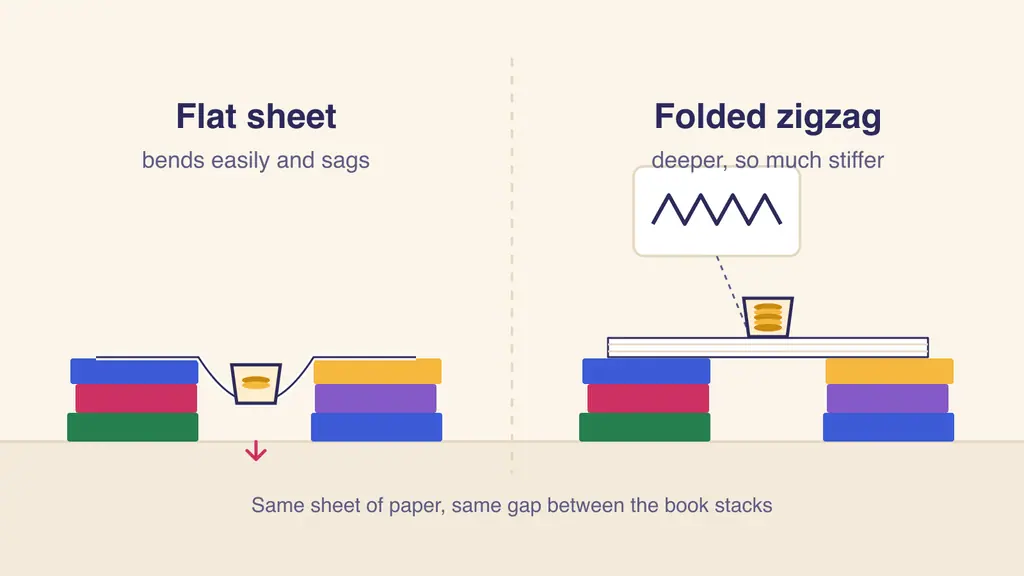
■ 10 · One-sheet bridge
Use: one sheet of paper and two stacks of books 8 inches (20 cm) apart. Rule: the bridge holds a toy car.
Make it harder: how many building blocks can it hold? Fold the paper to make it stronger.
■ 11 · Wind wall
Use: blocks or cardboard. Rule: the wall still stands after ten fans with a magazine.
Make it harder: make it taller than a ruler.
■ 12 · Ramp race
Use: a book, a piece of cardboard and a toy car. Rule: the car rolls past a line 3 feet (1 m) away.
Make it harder: the car must stop on a paper target.
■ 13 · The overhang
Use: blocks or books. Rule: part of your build sticks out past the edge of its base without falling.
Make it harder: make it stick out farther than the base is wide.
■ 14 · Back-to-back builders
Use: two matching sets of ten blocks. Rule: sit back to back; one person describes a build, the other copies it without looking.
Make it harder: no pointing words like "here" or "there".
■ 15 · Tube run ✂
Use: cardboard tubes, tape and a ping-pong ball. Rule: the ball travels from a chair seat to the floor through your tubes.
Make it harder: make the trip take five seconds or more.
■ 16 · Shelter for a figure
Use: paper, tape and a small toy figure. Rule: the shelter stays standing when you blow on it hard.
Make it harder: it needs a door that opens and closes.
★ 17 · Index-card tower ✂
Use: 20 index cards, 12 inches (30 cm) of tape. Rule: the tallest tower that stands alone wins.
Make it harder: no tape. Fold and slot the cards instead.
★ 18 · Shelf in the air ✂
Use: cardboard and tape. Rule: a shelf sticks out past the table edge and holds a full juice box.
Make it harder: it holds two.
★ 19 · Earthquake test
Use: blocks or cups on a baking tray. Rule: it survives ten seconds of gentle shaking.
Make it harder: build it twice as tall and test again.
★ 20 · Drawbridge ✂ !
Use: a cardboard box, string and tape. Rule: the bridge lifts and lowers with the string.
Make it harder: add a latch that holds it up. Safety: keep the string short and put it away after play.
★ 21 · Cracker drop
Use: paper, tape, cotton balls, a cracker. Rule: it survives a drop from table height.
Make it harder: use only one sheet of paper.
★ 22 · Newspaper stool ✂
Use: newspaper and tape. Rule: 6 inches (15 cm) tall and holds a hardcover book.
Make it harder: use fewer than ten sheets. (It's for books, not people.)
★ 23 · Rolling car ✂ !
Use: a small box, straws, pencils and bottle caps. Rule: it rolls 3 feet (1 m) after one push.
Make it harder: it rolls straight down a ramp. Safety: a grown-up makes the holes. Bottle caps are small parts: keep them from under-3s.
★ 24 · Blueprint swap
Use: paper, pencil, any building set. Rule: draw a plan, swap, and build each other's.
Make it harder: plans may use only shapes, numbers and arrows.
densters.com/printables/construction-challenge-cards/. Free to print for home and classroom use.
Prints on US Letter or A4 at 100% scale. In the print dialog, turn off “Headers and footers” for the cleanest sheet.
Sources
- Better Kid Care, Penn State Extension
- Building Blocks for Developing Spatial Skills: Evidence From a Large, Representative U.S. Sample (Jirout and Newcombe, Psychological Science, 2015), SAGE / Association for Psychological Science
- Small Parts Ban and Choking Hazard Labeling, U.S. Consumer Product Safety Commission