Some children walk into a busy playroom and light up. Others stop in the doorway, or start bouncing off the furniture within a minute, or retreat under the table with their hands over their ears. Very often the same child does all three on different days. Every child takes in light, sound, touch and movement a little differently, and a room that suits one child can be a lot for another.
A sensory-friendly playroom isn't a special kind of room for a special kind of child. It's a room designed with options: somewhere quieter, somewhere to move, lighting you can turn down, fewer things shouting for attention at once, and an easy way for a child to say what they need. Those changes tend to help everyone, including siblings and the grown-ups who share the space.
This guide focuses on the room itself. It isn't a substitute for individual advice. If you have questions about how your child responds to sensory input, your pediatrician or an occupational therapist is the right person to talk to.
Start by noticing, not labeling
Before you buy or move anything, spend a week paying attention to what your child seeks out and what they avoid. Understood, a nonprofit focused on learning and thinking differences, describes two broad patterns: some children are bothered by sensory input and try to avoid it, while others seem to need more input and go looking for it, often through movement or pressure. Many children show both, depending on the day, how tired they are and what's going on around them.
Useful things to jot down:
- Light: Do they squint, look away from bright windows or seem bothered by buzzing or flickering bulbs?
- Sound: Do sudden noises startle them? Do they seek out quiet spots, or make plenty of noise themselves?
- Touch: Are certain textures, clothes or messy materials a problem, or a favorite?
- Movement: Do they crash, spin, climb and jump, or prefer to stay still and grounded?
- Busy-ness: Is a crowded shelf inviting, or overwhelming?
Notes like these are helpful to share with a professional if you ever have concerns. They also tell you which of the ideas below are worth trying first.
Light you can adjust
- Layer the lighting. Give the room more than one light source so you can turn the overhead light off and still see. Plug-in lights should stay outside dens and away from fabric, with cords out of reach.
- Choose steady, warm LED light. Some children are bothered by flickering bulbs. Replace any that flicker or buzz.
- Soften the windows. A light, cordless shade or curtain takes the glare off a sunny afternoon.
- Battery LED lights for cozy spots. A battery-powered LED lantern or puck light can make a reading or calm corner feel enclosed without heat or cords. Our guide to lighting a fort safely covers what to use and what to avoid.
Sound and visual calm
- Absorb noise. Rugs, floor cushions, curtains and fabric wall hangings all soak up echo. Felt pads under chair legs help too.
- Offer ear protection as a choice. Some children like to wear soft over-ear defenders during loud play. Keep them in a known spot so a child can reach for them without asking.
- Cut visual clutter. Store most toys in closed or opaque bins with a picture label, and leave just a few things out on display. A toy rotation system makes this easy to maintain.
- Keep walls simple in at least one part of the room. Plain, muted colors behind the calm corner give the eyes somewhere to rest.
Zones: quiet, busy and moving
Divide even a small room into areas with different jobs, using rugs, shelves or simply the furniture you have.
| Zone | Purpose | Ideas |
|---|---|---|
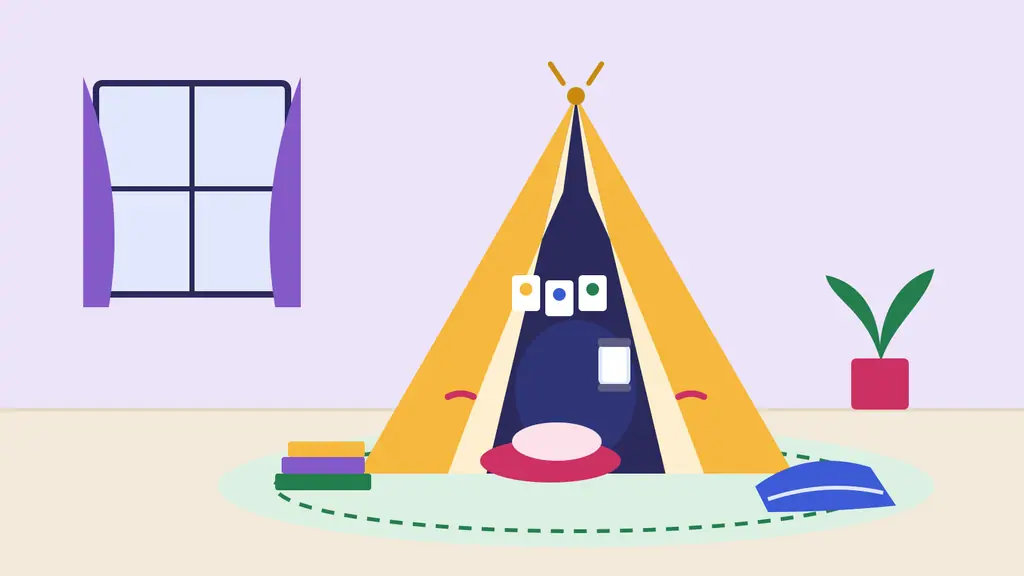
| Calm corner | Rest, recover, be alone | A small tent or curtained nook, cushions, a soft blanket, a few books, feelings cards |
| Building and making | Focused hands-on play | Low table, bins of blocks or art supplies, good light |
| Movement | Big-body play and "heavy work" | Floor cushions to crash on, a balance line of tape, tunnels, a beanbag to push |
| Pretend play | Stories and roles | Dress-up hooks, a play kitchen, puppets |
For the calm corner itself, our step-by-step guide to a calm-down den covers enclosure, ventilation and what to put inside. Understood notes that active, physical play such as jumping, pushing and climbing helps some children settle, so a movement zone isn't the opposite of a calm room; for many children it's part of what makes calm possible.
Clear choices
Children who find a busy room hard often do better when the options are visible and limited.
- Picture labels on every bin help pre-readers find and put away toys independently.
- A choice board shows a handful of activities as pictures. A child points to one, or to "break" or "quiet," without needing to explain in the moment. Our printable calm corner choice board is ready to use.
- Offer two or three choices, not ten. "Blocks or play dough?" is easier than "What do you want to do?"
- Signal transitions. A visual timer or a simple "five more minutes" warning makes the end of play less abrupt.
Safety first
- Anchor furniture. The U.S. Consumer Product Safety Commission's Anchor It! campaign advises anchoring all furniture with drawers, doors and shelves to the wall. That matters doubly in a room where children climb for sensory input.
- No cords within reach. Children have strangled on window blind and curtain cords, and the CPSC says cordless window coverings are the only way to eliminate that hazard. Move play spaces and calm corners away from any corded blinds, and keep lamp and charger cords out of reach and away from tents and dens.
- Cool LED light only inside tents and nooks: no candles, incandescent or halogen bulbs, and no plug-in lamps inside enclosed spaces.
- Ventilation and visibility. Calm corners should have an open side, use breathable fabric and stay visible from the rest of the room. Faces stay uncovered, and dens are never for sleeping babies.
- Soft, stable landing zones. Crash cushions go on the floor away from furniture edges, radiators and windows. Nothing heavy on top of tents or canopies.
- Age-appropriate items. Keep small parts, magnets, button batteries and anything small enough to choke on out of rooms used by toddlers or children who mouth objects. Cover unused outlets as the American Academy of Pediatrics recommends.
- Skip weighted products for young children unless your child's doctor or occupational therapist has advised them and shown you how to use them safely.
See our safety principles for more.
When to ask for individual advice
A sensory-friendly room is about comfort and choice, not treatment. Understood points out that sensory processing challenges are not a diagnosis on their own and often appear alongside other differences such as ADHD, autism or anxiety; occupational therapists are the professionals most often involved in assessing them. If your child's reactions to everyday sounds, textures or movement are making daily life hard, or you're simply unsure, talk to your pediatrician. They can help you decide whether an evaluation would be useful.
Meanwhile, start small: dim one light, clear one shelf, make one quiet corner. Watch what your child does with it, and adjust from there. More ideas live in the sensory-friendly play topic.
Sources
- Understanding sensory processing challenges in your child, Understood
- Sensory seeking and sensory avoiding: What you need to know, Understood
- Anchor It!, U.S. Consumer Product Safety Commission
- Window Covering Cords, U.S. Consumer Product Safety Commission
- Home Safety: Tips for Families With Young Children, American Academy of Pediatrics (HealthyChildren.org)