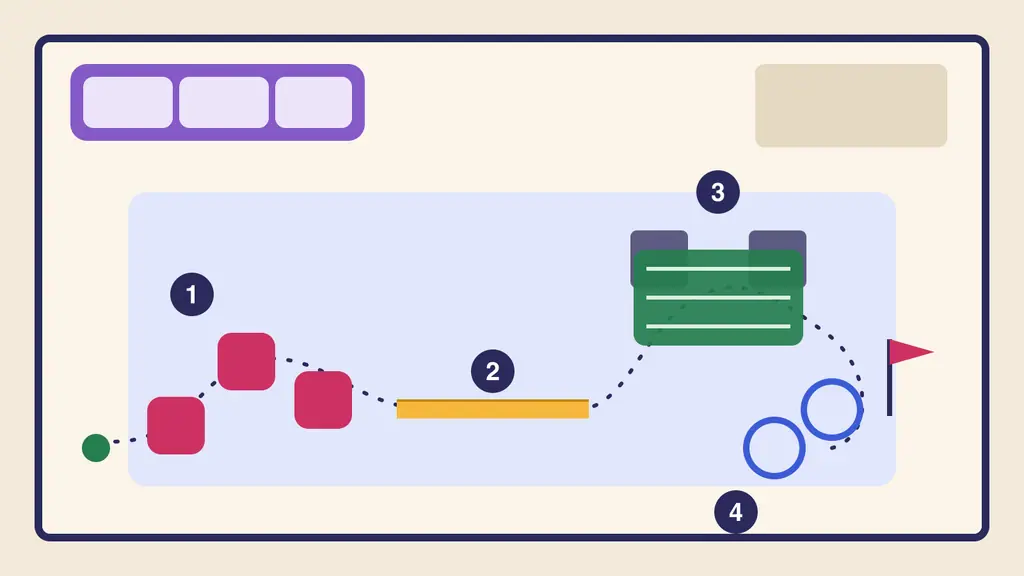
Crawl under the table. Hop across the cushions without touching the "lava." Walk the tape line like a tightrope, throw a bean bag into the basket, then ring the bell. Done? Again, but faster.
An indoor obstacle course is one of the most reliable ways to burn off energy when outdoor play is not an option, and it needs nothing you do not already own. Chairs, cushions, a blanket, painter's tape and a laundry basket make a course in fifteen minutes. Children can help design it, and once they have, they will want to rebuild it differently tomorrow.
The ideas here suit toddlers through early school-age children, with stations that scale up or down. The most important part is not the stations themselves but where you put them: on a clear, soft, non-slip floor, away from hard edges and anything that could tip.
You’ll need
- Painter's tape or masking tape
- Sofa cushions, pillows or folded blankets
- Two or three sturdy dining chairs and a blanket or sheet (for a tunnel)
- A large cardboard box with both ends open (another tunnel option)
- A laundry basket or bucket and 3–6 bean bags or rolled-up pairs of socks
- A pool noodle, broom handle or long cardboard tube laid across two stacks of books (for a low hurdle)
- A soft ball and a hallway for rolling
- A bell, pot lid or squeaky toy for the finish line
- Optional: a stopwatch or phone timer, paper and markers for station signs
Station ideas
- Crawl tunnel. Drape a blanket over two or three chairs placed in a row, or open both ends of a big box. Crawling through and out the other side is a favorite at every age.
- Cushion stepping stones. Lay cushions a short step apart. Children step or hop from one to the next without touching the floor. Put them on a rug or a non-slip mat so they do not skate away.
- Tape balance line. A straight line of tape, then a zigzag, then a curve. Walk it forward, backward, heel-to-toe, or carrying a soft toy on the head.
- Low pillow jump. Children jump from standing (not from furniture) onto a pile of pillows. Low means from the floor, landing on soft.
- Bean-bag toss. Stand behind a tape line and toss bean bags into a basket. Move the line back for older children.
- Hurdle or limbo. A pool noodle across two low stacks of books: step over it, or slide it up and go under.
- Animal walks. A sign that says "bear crawl," "crab walk" or "frog jumps" between two tape marks.
- Ball roll. Roll a ball along a tape "lane" down the hallway, or push it with a cardboard tube.
- Spin spot. A taped circle where children turn around three times (slowly) before going on.
- The finish. Ring the bell, high-five the timekeeper and start again.
Build the course step by step
- Pick the room and clear the floor. Move toys, shoes, cords and small objects away. Push coffee tables and anything with sharp corners out of the path, or pad corners with cushions.
- Check the surface. Use a rug or carpet if possible. On hard floors, put cushions on non-slip mats and have children go barefoot or in grippy socks.
- Choose 4–6 stations. Mix crawling, balancing, jumping and throwing. Fewer stations for younger children.
- Lay them out in a loop or a line, with clear space between each so one child's landing zone is not another child's start.
- Mark the route. Tape arrows on the floor or draw station signs with pictures for children who are not reading yet.
- Walk it yourself first. Test every station: does the tunnel stay up when bumped, do cushions slide, is there anything to hit at the end of a jump?
- Demonstrate once, then let them go. Show each station slowly, then let children take turns. Add timing only once everyone is confident.
- Change it up. After a few rounds, let children redesign the course, swap the order or invent a new station.
Variations by age
Toddlers (1–3)
Keep it to three or four stations: a short crawl tunnel, a few cushions to climb over, a tape line to walk, and a basket to drop bean bags into. Toddlers love repetition, so run the same course many times. Stay right beside them, holding a hand on balance stations, and skip jumping. The WHO recommends that children aged 1 to 2 spend at least 180 minutes a day in a variety of physical activities, spread throughout the day; a few rounds of the course count happily toward that.
Preschool (3–5)
Add a low pillow jump, animal walks and a hurdle. Preschoolers enjoy rules ("you can't touch the lava") and roles ("I'm the timekeeper"). Let them help lay out the cushions and draw station signs. The CDC says children aged 3 to 5 should be physically active throughout the day, with play such as jumping as an example.
Early school (5–8)
Children this age can handle six or more stations, a timer and challenges: do the balance line backward, toss with the non-dominant hand, carry a ping-pong ball on a spoon through the course. Let them design courses for each other or for a younger sibling, which is a design problem in itself. Our printable obstacle course station cards give them ready-made stations to arrange.
Safety first
- Supervise every round. A grown-up stays in the room, closer for toddlers and for any jumping station.
- Clear hard edges. Move or pad coffee tables, hearths and sharp corners. Leave space around every landing.
- No climbing on shelves or dressers. The CPSC's Anchor It! campaign advises anchoring furniture with drawers, doors and shelves to the wall to prevent tip-overs. Even anchored furniture is not part of the course.
- Keep jumps low. Jumps start from the floor and land on soft pillows. No jumping from sofas, beds, chairs or stairs.
- Non-slip surfaces. Cushions on rugs or non-slip mats; bare feet or grippy socks, not slippery socks on wood.
- Stable tunnels. Chairs should be sturdy and not slide; nothing heavy on top of the blanket.
- Windows and cords. The American Academy of Pediatrics advises keeping anything a child could climb on away from windows; keep blind cords out of reach.
- Small parts. Bean bags and balls should be too big to swallow for toddlers; use rolled socks if unsure.
- Take turns. One child per station keeps collisions down.
The general principles are on our safety page.
What they’re learning
What they're learning
- Movement skills. Crawling, balancing, jumping and throwing use the whole body. CDC and WHO guidance both stress daily physical activity for young children, and an obstacle course gives a rainy day a way to meet it.
- Planning and following sequences. Remembering the order of stations, or designing a new course, gives children practice holding a plan in mind.
- Playing together. Taking turns, cheering each other on and negotiating new rules are part of the fun. The American Academy of Pediatrics' report The Power of Play describes play with parents and peers as an opportunity to build social-emotional and self-regulation skills.
Grown-up tip
Grown-up tip: Put the course away in the same order every time, with tunnel chairs back at the table and cushions back on the sofa, and make tidying the final "station." When it is timed, children race to clear up.
Keep it going
Courses get better with a story: rescue the soft toys from the castle, deliver the mail across the river, or escape the dinosaur. Pair the course with a fort as the finish line, using our guide to building a blanket fort that stays safe. For more ways to fill a wet afternoon, see rainy-day activities by age, and if your space is tight, our ideas for big play in a small apartment include obstacle routes that fit a hallway.
Sources
- Child Activity: An Overview, Centers for Disease Control and Prevention
- To grow up healthy, children need to sit less and play more, World Health Organization
- Anchor It!, U.S. Consumer Product Safety Commission
- Home Safety: Tips for Families With Young Children, American Academy of Pediatrics, HealthyChildren.org
- The Power of Play: A Pediatric Role in Enhancing Development in Young Children, Pediatrics, American Academy of Pediatrics clinical report (2018), via PubMed